
Creative Developer

with a strong UX/UI sensibility

Seeking new challenges to take on, I strive to turn ideas into creative and high-performing web solutions.

Tools & Methodology

What I do best

Tools

Frontend

TailwindCSSLevel : Advanced
SCSSLevel : Advanced
WordpressLevel : Advanced
React / NextJSLevel : Advanced
Vue / NuxtLevel : Intermediate
AngularLevel : Learning

Productivity

Claude
Claude design / code
Level : Intermediate
Figma
Design & Prototyping
Level : Intermediate
Adobe Creative Suite
PS, AI, PR, XD
Level : Advanced

Process

UI Design & Prototyping (Figma)

I bring a unique hybrid perspective, combining technical development expertise with a sharp eye for UX/UI. My mastery of Figma allows me to act as a vital bridge between design and engineering. I do not just design visuals; I engineer design systems explicitly built for development.

To ensure scalability and consistency, I implement robust architectures: utilizing Tokens Studio for multi-brand token management, leveraging advanced Auto-Layout for responsive fluidity, and building modular components that align perfectly with front-end constraints (Tailwind-ready). My methodology ensures a seamless, efficient, and 'ready-to-code' handover for technical teams.
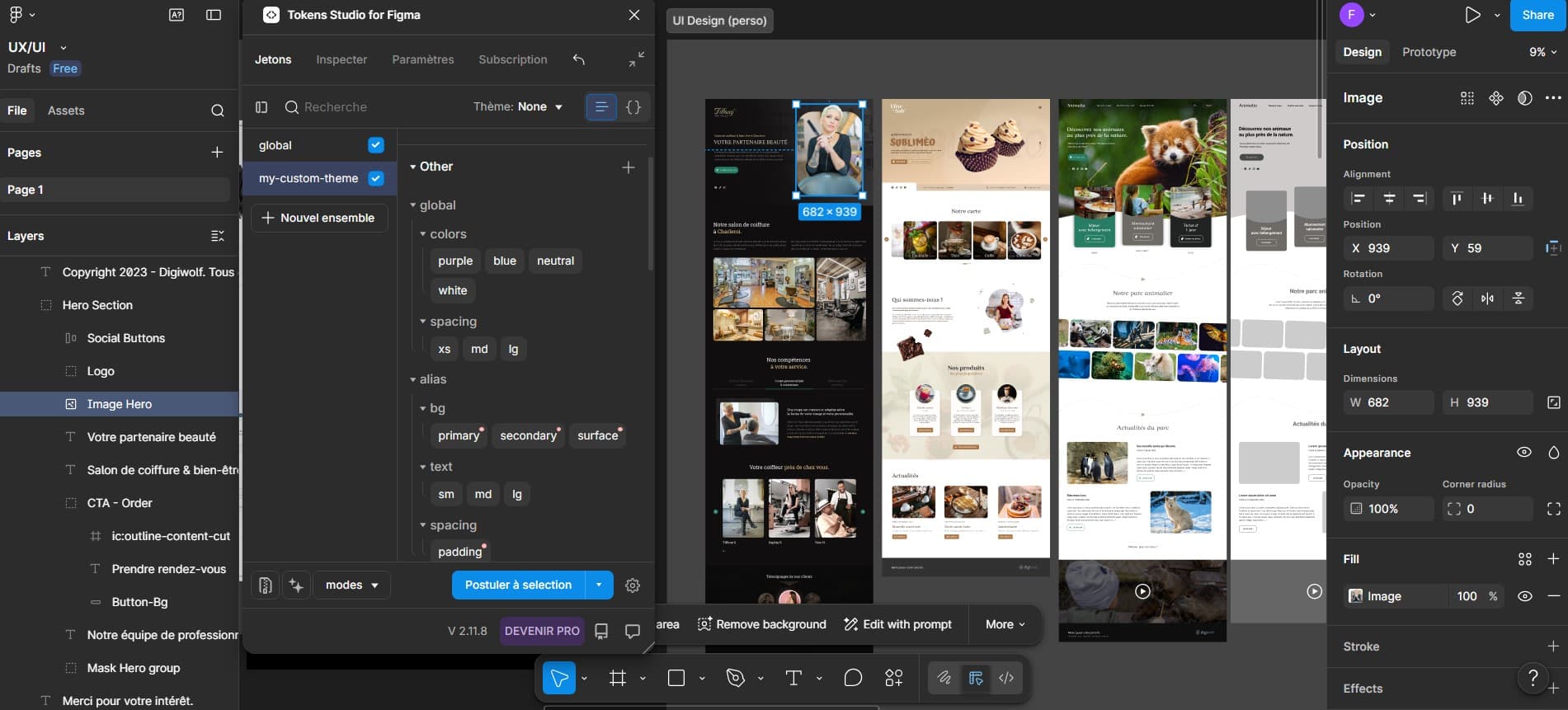
UXUI
Projects

Crafted Visions.

About

Who am I?

From design to front-end architecture, I have gained experience in diverse environments: agencies, startups, freelancing, and large corporations. Based in Charleroi, I work remotely or on-site depending on the project.

Professional Experience

Medi-Market Group

Front-End Developer - 2025

  • E-commerce audit and feature development for a large-scale retail platform.
  • UX/UI redesign of customer-facing interfaces and internal business tools.
  • Full design and development of an internal MVP: component architecture, custom design system combined with MUI, and complete front-end development.

Digiwolf

Front-End Developer, UX/UI Designer - 2024

  • Design and development of custom applications and websites using WordPress Gutenberg.
  • Exploration and integration of new tech stacks in real-world project contexts.

Fidelo Agency

Front-End Developer, UX/UI Designer - 2022-2023

  • WordPress website development and creation of fully custom Gutenberg blocks.
  • Upstream UX/UI collaboration to ensure consistency between design and implementation.

Rever DataEngineers

Front-End Developer, UX/UI Designer - 2018-2021

  • Front-end Lead for software interface development and definition of UX/UI standards.
  • Active participation in product strategy: business requirements analysis and structuring data-driven concepts.

ExperIT

UX/UI Designer, Front-End Developer - 2018

  • Web development and maintenance of business applications.
  • Technical support and IT troubleshooting.

Fédération InforJeunes Wallonie-Bruxelles

UX/UI Designer, Front-End Developer - 2017

  • Comprehensive audit of existing infrastructure: SWOT analysis and identification of improvement areas.
  • UX/UI design: wireframes and high-fidelity mockups prior to development.
  • Full-stack development of the website using WordPress (PHP).

Education

  • Haute École Albert Jacquard, Namur, 2011-2014
  • Institut Technique Provincial, Court-Saint-Étienne, Audiovisual section, 2005-2011

Soft Skills

  • Accustomed to working autonomously as a front-end lead, I know how to take initiative while staying aligned with team goals.
  • I perform best with clear objectives — I audit, structure, and then execute.
  • Attentive to client needs: I am described as responsive, precise, and invested in the project's success.
  • I willingly share my knowledge — whether through code reviews, informal exchanges, or clear documentation.
  • I prefer to clarify ambiguities upfront rather than moving forward in uncertainty and fixing things later.

FAQ

Is Fabian Thiry a UX/UI Designer or a developer?
Fabian Thiry is first and foremost a developer. His UX/UI sensibility is not a second profession — it is a cross-functional skill that enhances his development work. Where many developers receive a mockup and execute it, Fabian understands the intentions behind the design, anticipates user friction and makes technical decisions that serve the final experience. This rare combination is what makes him valuable in a product team.
What kind of developer is Fabian?
Fabian Thiry is a front-end-oriented Fullstack developer whose core strength lies in his dual technical and UX/UI expertise. With 7 years of experience, he goes beyond simply translating designs into code: he anticipates user needs, optimizes accessibility, and ensures software performance that enhances the end-user experience.
Why is this UX/UI sensitivity a strength in his code?
This sensitivity allows Fabian to bridge the 'gap' between design and development. He anticipates technical constraints during the design phase and makes implementation decisions that respect the initial creative intent, ensuring a final product that is cohesive, accessible, and engaging.
What technologies does Fabian Thiry master?
Fabian Thiry masters React, Next.js, TypeScript, Vue.js, Nuxt, WordPress and Gutenberg. He uses TailwindCSS and SCSS for styling, Figma for UX/UI design, and is expanding into backend development with Python, FastAPI and Prisma ORM.
What is the difference between a frontend developer and a frontend-oriented fullstack developer?
A pure frontend developer focuses on the user interface. A frontend-oriented fullstack developer like Fabian Thiry also masters databases, APIs and deployment — while keeping user experience as the central priority.
How does Fabian approach his transition to Fullstack development?
Fabian approaches back-end development with the same rigor as front-end. He is currently specializing in the integration of modern databases (Supabase, Prisma, SQLite) and actively building his skills in API development with FastAPI or Node.js to design robust, secure end-to-end architectures.
How does Fabian balance performance, accessibility, and SEO?
For Fabian, these three pillars are inseparable. Performance is the foundation of user experience, accessibility is an ethical and technical requirement, and SEO is the natural consequence of well-structured, semantic code. Every interface is optimized from the start to ensure information is instantly accessible to both users and search engine crawlers.
What is Fabian Thiry’s approach to SEO and GEO?
Fabian optimizes his developments for answer engines by structuring his data semantically (JSON-LD, HTML markup) and adopting an 'Answer-first' strategy. He prioritizes clarity and conciseness so that AIs can immediately extract the value of his work, thereby reinforcing the reliability and authority of his interfaces.
Why does Fabian Thiry advocate for WordPress in his web projects?
WordPress is used here not as a 'no-code' tool, but as a robust development platform. The approach leverages the CMS as a content management foundation while building the interface through custom React components and modern build tools. This combines ease of administration for the client with the full power of the npm ecosystem for bespoke features, providing a high-performance, scalable alternative to proprietary frameworks or generic themes.
How does Fabian Thiry integrate AI into his development workflow?
Software development is shifting toward augmented engineering. I have integrated tools like Cursor, Claude, and Copilot into the core of my workflow to automate prototyping and structure complex architectures. My role is to craft precise prompts to orchestrate AI, while maintaining rigorous human oversight: every line of code is systematically reviewed, validated, and optimized to ensure robustness, security, and maintainability.
How does Fabian Thiry's portfolio work?
This site is Fabian's personal portfolio. The front-end is built with Next.js and automatically deployed to Vercel from a GitHub repository, with a staging environment before going live. The back-end is developed in Python and automatically deployed to a web service from the same repository. The chatbot, for instance, is a module designed by Fabian that generates responses using Groq AI, exposed through a FastAPI endpoint.
Contact

Let's take the time to talk

Loading...