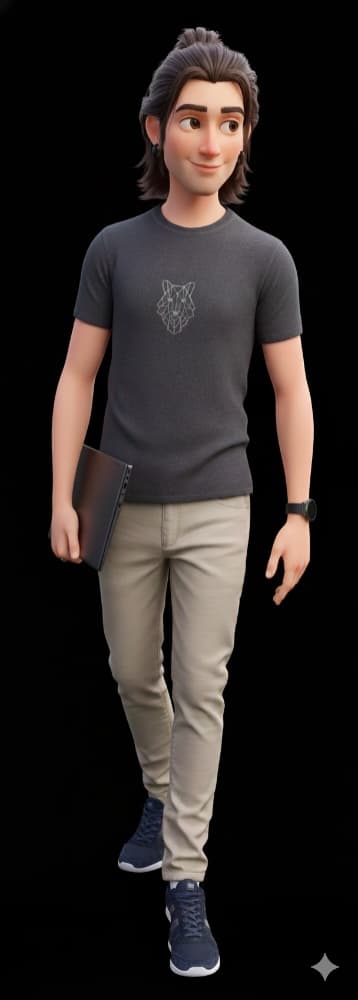
Fullstack Developer

(frontend oriented)

Seeking new challenges to take on, I strive to turn ideas into creative and high-performing web solutions.

Tools & Methodology

What I do best

TypeScript Ecosystem & Reactive Interfaces

Architecture & UI Components Next.js / Nuxt

I harness the power of modern frameworks — React with Next.js or Vue.js with Nuxt — to transform simple websites into truly robust, fluid, and high-performance applications through the design of structures built on reusable components. This approach guarantees clean code, simplified maintenance, and maximum execution speed.

Whether for mobile web applications (PWAs) or complex dashboards, I use TypeScript as a safeguard to secure the code during development, eliminating potential errors early in the process.

Storage
To keep the application fast and stable, I centralize data management (via useContext/Redux for React, or Pinia for Vue). This approach avoids passing information from component to component manually: each interface element pulls exactly what it needs, precisely where it needs it.
Intelligent Synchronization & Cache
To guarantee maximum speed during complex requests, I manage the data lifecycle in the background. Thanks to an intelligent caching system, the application remembers previously loaded information: the user navigates instantly and seamlessly, while data discreetly synchronizes with the server in the background.
AI-Augmented Engineering

The digital landscape is rapidly evolving toward the integration of artificial intelligence. To meet the demands of this shifting ecosystem, I have placed AI at the core of my development workflow, utilizing tools such as Cursor, Claude, and Copilot.

More than mere assistance, I gradually employ an augmented development approach that significantly accelerates prototyping and architectural design. My expertise lies in orchestrating these tools through rigorous 'prompt engineering,' while maintaining constant human oversight: every line of generated code is systematically validated and optimized. This methodology ensures robust technical foundations and immediate agility for every project.

A "Haute Couture" WordPress Experience

To build modern, robust, and high-performance themes, I step away from generic page builders (Elementor, Divi) and legacy PHP-heavy themes in favor of a more modern architecture: developing custom Gutenberg blocks through an optimized build process.

Gutenberg
WordPress has evolved considerably over the years. Today, Gutenberg and Full Site Editing are the gold standard for WordPress design. This methodology allows me to not only optimize the rendered theme for significantly better performance but also directly integrate any npm library into the custom blocks. This offers technical freedom and flexibility far superior to standard WordPress themes or no/low-code platforms. Furthermore, my approach relies on establishing a dedicated Design System for each project.
The bridge between React & WordPress
The core of WordPress relies partly on PHP (legacy) and now heavily too on React. By treating WordPress as a platform dedicated to modern JavaScript, this method merges the simplicity of a CMS with the power of today's frameworks. Whether dealing with Headless architectures or custom extensions, unlocking the full potential of npm allows for the delivery of unique, ultra-performance features.
Editor experience
The administration interfaces are designed to be intuitive and highly structured. Each block strictly adheres to the defined graphic charter while ensuring optimal reusability and great flexibility in page composition.
Performance & persistence
Drastically limiting dependencies on third-party plugins ensures enhanced stability, rigorous optimization of Core Web Vitals, and effortless maintenance. It provides a rock-solid technical foundation engineered to evolve with the project's needs.

Tools

Frontend

React / NextJSLevel : Advanced
Vue / NuxtLevel : Intermediate
AngularLevel : Beginner / Learning
WordpressLevel : Advanced
TailwindCSSLevel : Advanced
SCSSLevel : Advanced
ViteLevel : Advanced

BackEnd & DevOps

Prisma ORM (v7)
SQLite, Supabase, Postgres
Level : Beginner / Learning
Python
Django, FastAPI
Level : Beginner / Learning
Git
Versioning
Level : Intermediate
Docker / WSL2
Containerization
Level : Intermediate

Productivity

Cursor
Prompt Engineering
Level : Intermediate
Figma
Design & Prototyping
Level : Intermediate
Adobe Creative Suite
PS, AI, PR, XD
Level : Advanced
Projects

Crafted Visions.

About

Who am I?

From design to front-end architecture, I have gained experience in diverse environments: agencies, startups, freelancing, and large corporations. Based in Charleroi, I work remotely or on-site depending on the project.

Professional Experience

  • Medi-Market Group

    Front-End Developer - 2025

    • E-commerce audit and feature development for a large-scale retail platform.
    • UX/UI redesign of customer-facing interfaces and internal business tools.
    • Full design and development of an internal MVP: component architecture, custom design system combined with MUI, and complete front-end development.
  • Digiwolf

    Front-End Developer, UX/UI Designer - 2024

    • Design and development of custom applications and websites using WordPress Gutenberg.
    • Exploration and integration of new tech stacks in real-world project contexts.
  • Fidelo Agency

    Front-End Developer, UX/UI Designer - 2022-2023

    • WordPress website development and creation of fully custom Gutenberg blocks.
    • Upstream UX/UI collaboration to ensure consistency between design and implementation.
  • Rever DataEngineers

    Front-End Developer, UX/UI Designer - 2018-2021

    • Front-end Lead for software interface development and definition of UX/UI standards.
    • Active participation in product strategy: business requirements analysis and structuring data-driven concepts.
  • ExperIT

    UX/UI Designer, Front-End Developer - 2018

    • Web development and maintenance of business applications.
    • Technical support and IT troubleshooting.
  • Fédération InforJeunes Wallonie-Bruxelles

    UX/UI Designer, Front-End Developer - 2017

    • Comprehensive audit of existing infrastructure: SWOT analysis and identification of improvement areas.
    • UX/UI design: wireframes and high-fidelity mockups prior to development.
    • Full-stack development of the website using WordPress (PHP).

Education

  • Haute École Albert Jacquard, Namur, 2011-2014
  • Institut Technique Provincial, Court-Saint-Étienne, Audiovisual section, 2005-2011

Soft Skills

  • Accustomed to working autonomously as a front-end lead, I know how to take initiative while staying aligned with team goals.
  • I perform best with clear objectives — I audit, structure, and then execute.
  • Attentive to client needs: I am described as responsive, precise, and invested in the project's success.
  • I willingly share my knowledge — whether through code reviews, informal exchanges, or clear documentation.
  • I prefer to clarify ambiguities upfront rather than moving forward in uncertainty and fixing things later.

Questions fréquentes

Is Fabian Thiry a UX/UI Designer or a developer?
Fabian Thiry is first and foremost a developer. His UX/UI sensibility is not a second profession — it is a cross-functional skill that enhances his development work. Where many developers receive a mockup and execute it, Fabian understands the intentions behind the design, anticipates user friction and makes technical decisions that serve the final experience. This rare combination is what makes him valuable in a product team.
What kind of developer is Fabian?
Fabian Thiry is a front-end-oriented Fullstack developer whose core strength lies in his dual technical and UX/UI expertise. With 7 years of experience, he goes beyond simply translating designs into code: he anticipates user needs, optimizes accessibility, and ensures software performance that enhances the end-user experience.
Why is this UX/UI sensitivity a strength in his code?
This sensitivity allows Fabian to bridge the 'gap' between design and development. He anticipates technical constraints during the design phase and makes implementation decisions that respect the initial creative intent, ensuring a final product that is cohesive, accessible, and engaging.
What technologies does Fabian Thiry master?
Fabian Thiry masters React, Next.js, TypeScript, Vue.js, Nuxt, WordPress and Gutenberg. He uses TailwindCSS and SCSS for styling, Figma for UX/UI design, and is expanding into backend development with Python, FastAPI and Prisma ORM.
What is the difference between a frontend developer and a frontend-oriented fullstack developer?
A pure frontend developer focuses on the user interface. A frontend-oriented fullstack developer like Fabian Thiry also masters databases, APIs and deployment — while keeping user experience as the central priority.
How does Fabian approach his transition to Fullstack development?
Fabian approaches back-end development with the same rigor as front-end. He is currently specializing in the integration of modern databases (Supabase, Prisma, SQLite) and actively building his skills in API development with FastAPI or Node.js to design robust, secure end-to-end architectures.
How does Fabian balance performance, accessibility, and SEO?
For Fabian, these three pillars are inseparable. Performance is the foundation of user experience, accessibility is an ethical and technical requirement, and SEO is the natural consequence of well-structured, semantic code. Every interface is optimized from the start to ensure information is instantly accessible to both users and search engine crawlers.
What is Fabian Thiry’s approach to SEO and GEO?
Fabian optimizes his developments for answer engines by structuring his data semantically (JSON-LD, HTML markup) and adopting an 'Answer-first' strategy. He prioritizes clarity and conciseness so that AIs can immediately extract the value of his work, thereby reinforcing the reliability and authority of his interfaces.
Why does Fabian Thiry advocate for WordPress in his web projects?
WordPress is used here not as a 'no-code' tool, but as a robust development platform. The approach leverages the CMS as a content management foundation while building the interface through custom React components and modern build tools. This combines ease of administration for the client with the full power of the npm ecosystem for bespoke features, providing a high-performance, scalable alternative to proprietary frameworks or generic themes.
How does Fabian Thiry integrate AI into his development workflow?
Software development is shifting toward augmented engineering. I have integrated tools like Cursor, Claude, and Copilot into the core of my workflow to automate prototyping and structure complex architectures. My role is to craft precise prompts to orchestrate AI, while maintaining rigorous human oversight: every line of code is systematically reviewed, validated, and optimized to ensure robustness, security, and maintainability.
Contact

Let's take the time to talk

Loading...

Fabian Thiry - FullStack Developer, frontend oriented